I spent most of Super Bowl Sunday hiking in Finley Natl. Wildlife Refuge, avoiding having to watch the Packers win. The late winter cloud cover can be oppressive in this part of Oregon, but if you get a break in the weather between fronts moving in from the coast, you can witness some beautiful, somber skies.
We shot several scenes in A Country Wedding here a couple years ago. It’s one of those spots that has so many different settings packed into a few hundred acres. It can look like the Midwest or the deep South, with marshes and oak savannah surrounded by Doug fir forests. A few scattered farm buildings break up the skyline.
I hope we’ll be back there this spring for our next narrative project, a short film tentatively titled Slingshot.
Here I am back in my hometown of Chicago, slouching toward the birth of the new year, the year in which I’ll hit the big four-oh. Maybe it’s too soon to start in with the hand-wringing that usually accompanies the reaching of the rough middle point of one’s journey across this great green and blue rock. But navel gazing is a specialty of us writer-types, especially those of us educated by the MFA writing program industry.
Midlife crises are nothing new to me. I’ve been having them on and off since my teens when a sudden growth spurt ended my unlikely gymnastics career. I then turned to tennis, the Chicago Board of Options Exchange, a stint with a rock band, a pair of failed attempts at the Foreign Service Exam, three stabs over a fifteen year period at writing a Great American Novel, a solid near miss at writing for the screen and my current preoccupation with making a (low-budget) feature film of some sort.
Most of these endeavors have involved storytelling of one form or another. Partner that with my career in public relations and institutional communications, and it involves a whole lot of fiction. In short: bullshit. This penchant for stories arises mainly from a hell of a lot of movies and books over the years. I love both of these forms, and not a few of them have changed the course of my life as I’ve struck out in a new direction dragging my wife and kid along as I go. Books are dangerous and powerful things. Sometimes. Other times they put you to sleep. Often, at their best, they just make you smile and lay the pages in your lap, closing your eyes and savoring the funny way they make your brain feel.
Storytelling is an art and a craft and a compulsion. Some people do it really, really well. Some are just pretty good. Most suck at it. I haven’t quite figured out where I fit on that spectrum. What I do know, though, is that I’ve run out of roughly half of the time endowed to me to find out. And now the chances will grow slimmer with each passing minute. This doesn’t frighten or frustrate me that much. Sure I sense the sand slipping through the hourglass. But I’m also starting to approach an acceptance of the fact that I may never really know.
As a writer, I’ve been good enough to show well in a contest here or there. Outside my day job, I’ve earned a grand total of less than five thousand dollars for my scribblings. Not bad, actually. How many people have hobbies that pay them back? How many people approach, say, the watching of television like a part-time job? Instead, I tell stories. Sometimes people read them. Sometimes they even pay me for them.
Add to that a few plane tickets to LA, and one dinner in particular in Santa Monica that I recall where a producer asked me, without irony, who I’d like to play the lead role in the film of a screenplay I’d written. “What about Leonardo DiCaprio?” I asked. The producer frowned. I thought he might laugh. But he didn’t. He was thinking. “No,” he said, “don’t think we could get him. Who else?”
That film didn’t get produced. Neither did the next half dozen scripts I wrote outside of one short film, which I made myself with the help of friends. That turned out to be one of the more exhilarating storytelling experiences in this long, ambling and not very lucrative part-time career.
And while all of this other stuff was going on, this reading and writing and filmmaking, etc, I’ve wound up having a fairly rewarding actual career in another aspect of the bullshit biz. I’ve clawed my way up to middle management in a PR shop for a state institution, which sounds quite horrid but actually isn’t. I have no problems punching a clock, growing up as I did in a union household. My old man counted money in a dingy, smoky vault below crooked horse tracks under the direction of a state racing commission and various and occasionally nefarious wealthy families. For fun he golfs, dotes on a fancy car and for many years cared for and operated a speedboat, treating a host of family and friends to lake holidays over the years.
Instead of speedboating, I make up stories in my spare time. Instead of planning the union picnic, I make super low-budget movies. My endeavors may be a tad Quixotic compared to my father’s and his race track friends’, but they’re no less enjoyable.
I don’t want to give the actual, paying job short shrift. I’ve had some nice rewards, not the least of which being health benefits and a steady paycheck that over the years has enabled world travel and helped with the acquisition of not a few nice bottles of wine. We sent our daughter to a solid private preschool. Cutting corners means forgoing a vacation rental in favor of tent camping or putting off buying a new lens for my camera for a month or two. We’re not rich. We’ll never be rich. But, right now, anyway, we’re not hurting.
And building websites and helping put together marketing campaigns online has brought some creative satisfaction and a bit of recognition. It amuses me that I get to travel around the country and give presentations to folks about some of the things I do on a job I never expected or wanted in the first place. That’s not to say I don’t appreciate or enjoy said job. It’s just that I always thought I’d be doing something else. Like cashing checks from New York publishers or Los Angeles producers.
But I’ve learned that this isn’t really how the world works. Maybe for some people, but not for the vast majority. As I slouch toward forty, I’m realizing that this kind of sucks, but then it’s also not really that bad. If I could have my choice of a career, I’d be sitting in a book-stuffed cabin near Sisters, Oregon with a view of the three volcanic peaks, hacking away at a vintage typewriter, amassing pages, which I’d slip into an envelope and send to an agent. Every so often, a check would come in the mail. I’d occasionally get up to split wood and feed the fireplace. I’d pick my daughter up from school and then fix dinner for the family. In the evenings we’d watch Francis Ford Coppola movies or I’d actually have time to read the New Yorker weekly. On weekends I’d fish for trout or sketch landscapes. Maybe I’d take photographs of flowers with a macro lens.
But that’s not how it works. Maybe reaching forty means that you begin to accept and realize what’s fantasy and what’s not. Right now my goals are less ambitious than the National Book Awards or the Academy of Motion Picture Arts and Sciences. I’d like to get a little nicer house so that we can have guests without feeling cramped. I’d like a six-burner stove and more time to cook. I’d like to be a little less stressed at work and have a little more time to engage in bullshit artistry: I’d like to take a shot at another novel or script. Maybe one will be something I’m really, really pleased with, whether or not it’s ever published or produced. I want to fish more, go backpacking with my daughter, and increase the number of times per year that my wife and I take in dinner and a show.
All of these goals seem reasonable. I even hope to accomplish one or two of them in 2011. And the rest should be easily attainable sometime over the next forty years.
Our short film, A Country Wedding, will be screening this Saturday, October 16 at the Salem Film Festival. It seems like ages ago that we wrapped production and eventually premiered at the Da Vinci FF, so I’m excited to get back and see it on a big screen again.
Infatuated with his cousin Charity since childhood, Jake is an emotional wreck as he’s forced to not only attend her shotgun wedding to the town loser, but to also serve as the best man. When called upon to make a speech that he was unprepared to give, Jake finds himself admitting his true feelings for his cousin in front of the entire congregation. A Country Wedding is a sad, funny, small town tale of love gone wrong.
So come check it out if you’re in the mid-valley area this weekend.
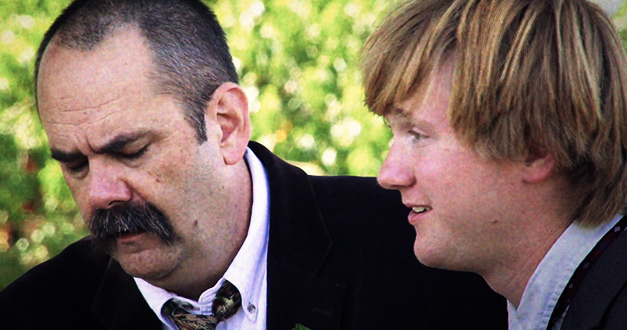
Actors Paul Turner and Eric Lehman from A Country Wedding.
A Country Wedding will be showing this Saturday, March 13 at the Da Vinci Film Festival in Corvallis. Looking forward to finally seeing our hard work on the big screen, and a party with the cast and crew afterwards.
We boxed up copies of the film for the cast and crew.
Sammy was cold when I found her this morning on the couch. There wasn’t shock or surprise…she’d been dying hard for the better part of a week. Mainly there was relief: I was thankful she was no longer suffering; I was grateful I didn’t have to watch her waste away any more; glad that I didn’t have to wrestle syringes of mushed cat food down her throat with the faint hope that this might somehow re-start her system.
In the end she died, and I took her out and buried her in the flower bed. We’ll plant a fern over her and find a concrete statue that resembles her in her prime, and we’ll remember an awesome goddamned cat.
Even people who hate cats loved Sammy. Partially it was that she acted like a dog: greeting you at the door, climbing all over you, desperate for affection, desperate to win your approval. She was cussed out not a few times when we tried to work and she’d be there calling for attention. She weathered the abuse of a growing child who treated her like a doll and carried her around the house once she grew too old to outrun her. When Bailey was an infant and we closed her in her room at night to cry herself to sleep because that’s what some stupid book told us to do, Sammy, who knew better, would sit outside the door with a look of pity concern until the crying stopped.
Within minutes of meeting her, even the most hardened cat hater and most macho dog lover would be absently petting Sammy as she snuggled into his lap. You couldn’t help yourself. She worked harder at melting hearts than any creature I’ve known. You open yourself up to ridicule, I suppose, writing a eulogy for a cat. Even a cat lover like Hemingway wouldn’t stoop to this. But I gave up being a serious writer a long time ago. Screw it, I’m going to eulogize.
Sammy sat on my lap while I wrote three thousand pages of drivel…two finished and unpublished novels, and two stillborn epics never completed despite amassing an ungodly number of pages. She outlived my desire to be a Great American Novelist. She spent many late hours purring patiently as I wrote a few screenplays that fared a little better than my novels, and as I burned oil until well past midnight launching armadas of marginally useful emails for what is colloquially referred to as a “real job.”
In the end, she never judged. She just wanted a warm hand to slick back her fine gray fur. She wanted to wedge her chin against your cheek and make a burbling noise not unlike a coffee percolator that would slowly unravel your frayed nerves and remind you that you aren’t alone in the world with your toils, and how the simple things, like the humble acknowledgment of the fact that other creatures exist and breathe and want nothing more than a scratch under the chin, can change your attitude. Sometimes it takes another species to remind us that we’re human.
Sammy had a good life. Nancy picked her out at a shelter fifteen years ago. She was scrawny, wearing her rib cage like a corset, blowing snot and twisting her bony, patchy body around our legs. For some reason, this little mongrel won Nancy’s heart even though she didn’t look like much to me. We spent a couple thousand bucks, which was a lot when you’re making $6.50 per hour on the night shift at Kinko’s, getting her healthy, and she spent the rest of her life showing us her gratitude.
Thanks, little gray buddy, for the gift of your friendship. I’m reaching out my hand now, and for the first time in fifteen years a grumbling, mewing, sleek little creature isn’t leaping out of the shadows to arch her back under my fingers. That’ll take some getting used to.
She’s six years old and has three failed adoptions and suffered a number of smaller atrocities, but now she’s sprinting up the beach against the wind, clutching the pink leash of a borrowed Labrador, the wind swallowing the frantic shouts of her foster mother and the dog’s owner.
She strains cold air through her teeth, not quite a grin, and the blown sand that crusts her lashes and snakes over her receding footprints scours this hard child’s shell. Inside she’s all mush and hurt, but that shell, man, it’s something. You could break bottles on it.
She’s never before seen the sunset or the ocean, and this sudden confluence has her on a high. She trusts the dog and the reckless, headlong strides and the taste of the salt air, gulps of crab rot, kelp and bird shit.
She doesn’t understand her crimes, even less so the sentence, but the pounding of her feet, the tiny splash of each stride on the wet sand…this feels very real and solid to her.
Her brown hair is a ribbon, a salt-sticky pennant streaming behind her. The dog’s tongue lolls and flaps, and there are three princesses and sequins stitched into her garage sale sweatshirt.
She doesn’t know that regular children aren’t in the habit of screaming themselves to sleep at night, and they will assert their rights with tooth and claw only at their peril. Punishment doesn’t really work on her. “Is that all you got,” she grins back over her shoulder.
She also doesn’t know that the Labrador, who gallops ahead of her, tugging on the leash, aware only of a gull in the distance and this strange little creature in tow who is indulging her penchant for headlong flight, has only this morning chewed the armrest off of the sofa and that she shits regularly on an heirloom throw rug, the oblivious creature persisting only through the owner’s sense of duty.
She glances back only briefly to see her latest mother and the dog’s owner both waving and cupping their hands to their mouths to shout into a wind that sucks the voice out of their words before they even cross their lips. Then the Labrador snaps the leash and puts her head down to gallop with redoubled stride, as if to say, “come on, kid, now’s our chance.”
She squeezes her eyes shut and trusts the leash and the yellow plug of fur and muscle at the other end, not heeding the voices she can no longer hear, not even sensing that the big people far behind her are, without even admitting it to themselves, both hoping that these two girls just keep on running.
Astrakan Films is developing my script, The Eulogist. William Olsson is a talented new director, and he’s got an amazing and ambitious vision for this story. William’s not the type of guy to shy away from big stories. I can’t wait to see him bring this project to the screen.
Any reader who is also a writer understands that questions will rattle in your head as you wend your way through a work of fiction. Unlike regular readers, you can’t simply be subsumed by story, sinking into the world that the author has labored to create. Like a retired engineer you have to kick the tires, lift up the hood, puzzle through how this contraption was put together.
This is part two of a Q&A with J. Adams Oaks, the author of the hot new YA novel Why I Fight. The great thing about knowing writers, especially writers as talented as J. Adams Oaks, is that those questions need not merely echo around in my head. I can kick them over to Jeff and get some actual answers and insight into the process he went through in creating his amazing book. So let’s lift up the hood…
Your novel has one of the most distinct and unique narrators I can recall. As soon as I finished “Why I Fight” I went back and read your story “Ash Butterflies” in Hair Trigger 21. Two things struck me. First, it’s amazing how the promise of this novel is contained in that story: the voice, the characters, your rich attention to detail.
But Wyatt’s voice in the novel has also grown since that early story…his wide-eyed, childish innocence has been colored by an edge of street smarts. He’s developed quirks and narrative traits that bring him to life. What happened after the publication of that story? What elements led to the evolution of Wyatt’s narrative voice?
First, thanks for the kinds words. I do think that Wyatt Reaves was much more naive back then, because “Ash Butterflies” was his very first incarnation and it was really that scrawny scared 12 and 1/2 year old sitting in his parents house alone for days on end telling that initial story. It’s that voice, more than anything, that made me want to carry the story forward. I couldn’t get his voice out of my head and I couldn’t help but wonder who these people were around him.
So I listened. The thing is that his story moved forward and he grew, so his voice aged and honestly, innocence can last only so long and then it gets really annoying, you know like a character in a Disney cartoon. So once I realized where Wyatt was going, I had to go back and revise his understand of his situation and the story. My amazing mentor, advisor and friend, Randy Albers, Chair of the Fiction Department at Columbia College and I had long discussions as to how distant Wyatt was from the telling. Randy encouraged me to see it from a 40-year-old Wyatt’s eye, but I just couldn’t hear that person. I couldn’t even imagine him that far into the future, and honestly I didn’t know if he even made it that far. So we hear it from a nearly 18 year old, who thinks he understands the world a bit, but really is only starting to see it. That’s what makes me so excited for him, he’s moving toward a beginning.
The story “Ash Butterflies” has become the emotional climactic scene of “Why I Fight.” All of the core elements are there, though the version that appears in the novel is leaner and more headlong.
Okay, well, I always saw the short story as the beginning of the Wyatt’s adventure, because most of it is told fairly chronologically. But, as I started to work with my phenomenal editor Richard Jackson on the 2nd and 3rd drafts, the story really became this close-up, intimate telling with Wyatt next to you on a bus talking to you just inches away. And because Wyatt was talking to you, a stranger, my editor asked me, “Would you tell your most shameful secret to someone you’d just sat down next to?” And he was right, there was no way he’d admit to what he’d done; he’d have to really sink in and feel comfortable before he could admit the truth.
Why I Fight
Did you do this much trimming throughout the book during the editorial process? Were there any moments that you hated to give up?
That novel was as big as 350 pages and as trim as 175. I wrote 5 complete new versions over the years. Each was this amazing learning experience that had a specific reason it needed to exist, so there was also expanding and removing and adding back in and shuffling of chapters and reshuffling and on and on. It was intense and insane, but I’m a much better writer for it.
I did hate giving one chapter that had Wyatt and Clark, his only friend, spending time together, but my editor said if it didn’t have a purpose other than them spending time together, it needed to go. I loved it. Sure, it did some stuff, but I couldn’t figure out why I needed it, so it’s gone (of course, nothing is truly gone with computer now, so I’ll tuck it away for another day…). But for the record, I L-O-V-E editing and trimming. I love to write a bunch of STUFF and then, like a puzzle, try to figure out how the words can be there best.
The novel has an urgent, headlong pace. It’s hard to put down. This is helped along by the structure, particularly the short chapters, averaging 5 pages. When in the process did you arrive at this structure? What were the advantages of breaking the story down in this fashion?
Honestly, it was done in the last draft of the book and it was after Richard Jackson and I had discussed how young adults would see the book. He mentioned shorter chapters are better for young readers to feel a sense of accomplishment as they turn the page.
I remembered back to my childhood and that feeling of reading before bed and thinking, “I’ll read through this chapter and then I’ll sleep.” Or I’d check to see how much further I had to go. But it also serves the purpose of keep that pace that Wyatt is keeping and keeping anecdotal as it would be in a longer conversation. Plus I think it’s good for my adult friends who read it on the L here in Chicago and can read a couple chapters on the way to work!
How did you arrive at the title?
Oh, the title… Hmmm… Okay, so the original title for years was “Shreds” which came from the image of Wyatt tearing up comic strips and burning them, but obviously referred to the larger shreds of Wyatt’s life. Once the book evolved into this intensely intimate first-person narrative, wise Mr. Jackson asked me a simple question that would stump me for A VERY LONG TIME. He asked me, “Don’t you think that Wyatt deserves to title his own life?”
Well, damn it. How could I say no to that. But what would you name your own life, you know? That’s not as easy as if sounds. And certainly not for a 17 year old. So, I brainstormed and brainstormed and emailed them to my editor. Often times, I’d come home from a night out drinking, and I’d sit down at my computer and make a list of 10 or 20 that I’d shoot off to Richard, he’d reply in the morning with the two or three he thought were okay, but not quite right, we were getting there, keep going, he’d tell me. And somehow, maybe with the bourbon helping the creative flow, WHY I FIGHT was in one of panoply of lists. FINALLY! It felt right. It sounded proper. I think Wyatt would like it, you know?
One of the many vivid, visceral scenes in the book has Wyatt killing and cleaning fish at Spade’s insistence. I can still recall a version of this scene that your read in class more than ten years ago. Was that always a part of this novel? If not, when did you realize that it was part of something bigger?
No, that was always part of the book. And yes it started in that class, me trying to understand Wyatt and Uncle Spade’s relationship. It always felt very defining for the two of them.
There are so many emotionally charged moments in the book, like Spade’s confrontation with Lynnesha, or when Wyatt grabs Clark by the throat. Was there any scene that was particularly challenging to write or especially draining for you as the writer?
Without giving away the scene with Lynnesha and Spade finally confronting each other, I’ll say that it was one of the most difficult, because as I got into it, I kept saying to myself, “I don’t want this to happen… Is this really happening? What’s going on?” and it had to happen. It was the story telling me what it needed. The violence was overwhelming to me.
So many other people are upset by the killing of fish and tadpoles, but man that confrontation gets me every time! Wyatt and Clark having it out, was actually taken out of the book and then added back into a much later draft. I relished writing it, not for the violence by any means, but for the moment Wyatt is really claiming how he feels and standing in it so fully. I love imagining him standing in the woods, clenching giant fists as the rain trails off them, his brow furrowed. That’s like a movie scene for me!
This is a road novel that carries Wyatt and Spade across the country. Did you hit the road while you were working on this book? How did you capture the sights and smells of the state fairs, the salvage yards and the seedy motels?
I didn’t do much road-tripping while writing the book, but I did take one specific vacation before my last semester of grad school; I had a week off, rented a car and drove only rural routes and back roads all the way to Boulder, Colorado and back. I journalled a lot along the way.
Most of the book was actually written while I lived in Denver. Two of my closest friends, Claire Fallon and Steve Kalinosky, were kind enough to let me live with them for free as long as I wrote every day, so I committed to 4 hours daily. And Colorado was so foreign to me as a midwesterner that it certainly helped me truly pay attention to The Road. I should also say that my parents are academics, so we all had summers off and our vacations were in the family station wagon seeing as much of the U.S. as possible. Thought I didn’t really appreciate that education until I was much older.
The whole novel is framed as Wyatt spilling his guts to a stranger on a bus, with the reader standing in for the stranger. How did this device come about? You can truly hear Wyatt’s voice in your head. Did this structure help to develop that voice?
After Richard Jackson decided to work with me on the book, he asked me a question that I’m sure you and I were asked frequently in classes at Columbia: “Who is Wyatt talking to?” I answered quite flippantly, trying to dismiss this extremely important question, I said, “He’s talking to a stranger on a bus.” Dick answered, “Well, if that’s so, you haven’t written that book.”
We talked about what that situation would really contain: only enough information during a bus ride, a public conversation, a censorship of language, etc. So I worked on an entire draft considering what Wyatt was saying to this “stranger.” Eventually, in later drafts that stranger became the reader. And in the second to last draft, Dick asked me read the entire book out loud to myself, and if I couldn’t say it then it wasn’t working, if it didn’t fit in my mouth then I had to consider whether it needed to stay. It was amazing to read the whole thing over a couple days. It made me hear those flowery sentences that were the author or the narrator over pouring Wyatt’s voice. It made that voice really come first.
The entire novel is linear except for the fire scene near the end…why did you decide to jump back in time right at that point of the story?
I think I accidentally answered this earlier. It felt like Wyatt just couldn’t admit to what he’d done until he felt comfortable with the listener, the stranger.
Nana, with all of her quirks and eccentricities, is one of the colorful characters that sparkles in this story. How did she come to play such an important role? And where did the crates of glass come from? How did you decide to give Wyatt his ever-present piece of “Nana glass” to hold on to?
Nana was one of the first characters developed in grad school after I’d written “Ash Butterflies.” I’m not sure what exercise we were doing in class, but she really came to life pushing that grandfather clock, surrounded by cats and crates. I wasn’t sure what was in the crates at first, but once I saw the glass, I couldn’t stop thinking about it. Why did she have it? What made her do it?
I sort of figured that something broke lose inside of her when she lost her husband and so she found this manic behavior to occupy her time. Wyatt’s Nana glass is up for your own interpretation, but I know that constantly trying to understand his family and that is just a little piece of it for him.
How have audiences been responding at readings? Are you still taking the book around on tour?
Ah, the “book tour.” I seriously thought that was a real thing. I mean, I’m sure that well-known authors with a serious track record or maybe authors with small presses might be taken to a few cities by their publishers, but at this point there is so little money in publishing that the houses are struggling to keep afloat which means authors are left to self-promote and that is like taking on a 4th job.
I’m trying to visit friends around the U.S. and use the visits as stops to do readings. I’m going to North Carolina, where my brother and his family live. I’ll read for a couple book clubs and maybe a bookstore. The readings themselves are a blast. I love talking to folks about the book and seeing people excited. I’m especially excited to get responses from young adults. I did a reading in Prairie du Sac, Wisconsin month back and two young boys showed up, dropped of by their parents. They sat in the front row and wouldn’t look me in the eye they were so nervous, but as soon as I opened it up to questions they raised their hands and came up with some of the most astute observations I’ve gotten so far. They seemed to really “get” Wyatt. And that makes all the hard work worth it!
Wyatt Reaves takes the seat next to you, bloodied and soaking wet, and he is a big-fisted beast. Tell him to stretch out like an X across asphalt and you’ve got a parking space. But Wyatt’s been taking it lying down for too long, and he is NOT happy.
Since he turned twelve and a half, he’s been living with his uncle, a traveling salesman of mysterious agenda and questionable intent. Soon, Uncle Spade sees the potential in “kiddo” to earn cash. And that’s enough to keep the boy around for nearly six years.
But what life does Wyatt deserve? Alcohol? Drugs? Bare-fisted fights? Tattoos? No friends? No role models? Living in a car?
If you’re brave enough to stay and listen, you’ll hear an astounding story. It’s not a pretty road Wyatt has traveled, but growing up rarely is.
Praise for WHY I FIGHT
“A breathtaking debut with an unforgettable protagonist…His painful and poignant story is a wonderful combination of the unlettered and the eloquent.” –Booklist (starred review)
Don’t call me kiddo. I REALLY hate it. People been calling me that way too long. Fever and Ma and Uncle Spade all call me kiddo, and it makes me crazy. See how I ain’t smiling? People who know me, know that means trouble.
J. Adams Oaks is the author of the new young adult novel WHY I FIGHT
So begins the new novel by J. Adams Oaks, Why I Fight, which is already earning glowing adjectives (poignant, breathtaking, unforgettable – Booklist). It’s the story of a 12 year old bare knuckle boxer from a dysfunctional family, and from the pugilistic prose you might think Jeff is the type of writer to step in the ring with Papa Hemingway. But in truth, he’s more of a Faulkner guy, with a little Toni Morrison and Gabriel Garcia Marques thrown in.
I attended Columbia College Chicago ten years ago, where I had the great pleasure of watching the inception of the story that became Why I Write. The Fiction Writing Department at CCC doesn’t tell writers how to write, instead, they cultivate voice and foster the conveyance of rich imagery in prose. And did they ever cultivate the hell out of Jeff. His first book, more than ten years from inkjet to hardcover, is amazing.
This is part 1 of a two-part Q&A.
So what have you been up to for the past ten years?
Wow! So much. I’ve finally found a good balance of writing, teaching, and bartending to pay the bills. The novel, WHY I FIGHT, in its first form was my thesis for Columbia College Chicago. I tried working a 9-to-5 job and write, but that didn’t work, so I actually moved to Denver, CO into the house of my friends, Claire Fallon and Steve Kalinosky, who let me live with them for free as long as I was writing every day. I cranked out that first draft, then started bartending while I looked for a literary agent. That took me four long years during which I rewrote the manuscript and told everyone I met that I’d written a book and was trying to publish. I actually got referred to my agent through a regular at my bar!
What’s the worst job you had during that time?
I have to say for me personally the worst job I’ve had was the 9-to-5 cubicle farm job, commuting into The Loop into one of those beige buildings into an office with no windows at a grey desk. I never was a morning person, so I pretty much spent my day yawning and waiting to get home to sleep. It’s hard to find your creativity doing that, you know?
Why I Fight
I’ve always had an aversion to the old dead white guys of the traditional cannon, because they were the ones I was being told I had to pay attention to and connected to the least. All through undergrad and grad school, I searched out the people that didn’t live like me, that didn’t write like me and who’s voices sounded nothing like mine so that I could really see how they found their own sound. I studied Spanish lit and Latin American writer, like Lorca and Borges and Garcia Marques. Later on in grad school, as I started to find my main character, Wyatt Reaves’, voice, I really started to pay attention to Sandra Cisneros and Junot Diaz and Herbert Selby for their powerful individual expression of singular voices. I also love reading in the morning before I start, reading to be inspired, to feel that feeling of “I want to try to do that!” so I’ll read Toni Morrison or William Faulkner or poetry or even a friend’s work until I just have to turn to my own writing.
Do you feel any different now that you can wander into a bookstore and find your work on the same shelves as writer’s you’ve admired your whole life?
Funny you should ask, because that’s what I’ve been telling everyone: “I just want to be able to walk into the local bookstore and see my novel there, then I’ll feel satisfied, feel relieved.” I’ll also say that I’m glad that Joyce Carol Oates wrote a Young Adult book, so mine can sit next to hers.
Like a lot of writers, you spent time studying your craft in an MFA program. What was the most important aspect of that experience?
Boy, I’ll tell you that for anyone looking for an MFA program, I really recommend checking them out to find one that works for you, because everyone has different needs. I was so impressed by Columbia College’s Fiction Department, which emphasized oral storytelling translating to the page and really find one’s voice as well as reducing the amount of pointless criticism and competition that can occur in other programs. The only competing I felt with my colleagues at Columbia was, “Man, I want to write something as good as that. Now how did she DO that?!?!?”
What have you learned in the years since graduating? How have you changed as a writer?
Oh, jeez. That is a hard one. I’ve learned so much by being active in a vibrant literary community like that in Chicago. I’ve been active in an astounding theater company called Serendipity that produces “2nd Story” which is a highbred a reading and a performance. You can check it out at www.storiesandwine.com. I’ve gotten to learn how to really stand in front of an audience and give my voice. I’ve also had the opportunity to work with one of the best editors, Richard Jackson, a truly talented man who understood how to guide me as a writer toward the strongest writing. He knew I needed to do all the work, when it came to page, letting me learn along the way through 4 FULL rewrites of the book! And the list goes on of what I’ve learned, because I feel like as artists we have to be constantly learning or we get stagnant.
How long did it take you to get to the heart of “Why I Fight?” How long have you known this story was a novel?
You know, I think “the heart of WHY I FIGHT” was what told me it would have be a novel. At the time I wrote the very first scene, which I assumed was a short story, I felt like there was something much larger there, and if I listened carefully it would tell me what else it had to offer. I feel like Richard Jackson taught me to really listen to what the work demands and not force it into something it’s not. So to answer your question, I think that WHY I FIGHT was always a novel, whether I knew it or not….
You’ve been working on this project for a long time. During that whole time were you ever tempted to abandon that project and focus on something else, or abandon writing altogether?
I never thought about abandoning writing. I’ve always known I’d do that whether it was seen by others or not, but there was a drive there to share my work with more people than just family and friends. I did work on this book a long time. I finished the first draft in 2000, and the reality is that it sat in a drawer for 4 years while I did the business of writing, that’s the other side of it people don’t really talk about enough. Art requires some serious drudgery as well as creation. I do think though that a writer should have more than one project going so that they don’t get sucked into the whole of that one work. I always seem to have 5 or 6 documents on my computer’s desk-top and I pop into whichever is taking my attention that day. The worst thing is to work on something that you can give no passion.
What gave you hope or confidence along the way?
It’s really the who that gave me hope. Everyone I work with on writing wants everyone else to succeed, so we are all pulling for each other. Not to mention, Mom and Dad. But I also have to say, writing is my career and a career just takes putting aside the insecurity and getting down to business, you know?
Where do you turn, outside literature and writing, for inspiration?
Everywhere! It’s the world. I carry a little journal with me all the time so I can write down a conversation I over hear on the bus or a description of a bit of graffitti I see or a name or an adjective that tastes good in my mouth. I’m writing all the time. That’s a blessing and a curse.
If you were to take a road trip to clear your head, what type of vehicle are you in, what’s playing on the stereo, and where is the road?
I don’t own a car, since I live in the city and take the train, so ANY car would be great! I’d love a sun roof and a really big stack of CDs including some great jazz, bossa nova and some surprises. That road would be heading toward water because I really really REALLY could use a little time at the beach. Sigh. But I’d have to take my journal with me, even if I was on vacation. I don’t want to miss anything.
What’s next?
I am working on #2. It’s tricky to find time when I need to work on getting the first one out there, but I’m so glad to have something else to work on. It takes place partly in Spain, soooooo…. I’m thinking research trip is in my future, right? Wish me luck and I’ll keep you posted.
Wyatt Reaves takes the seat next to you, bloodied and soaking wet, and he is a big-fisted beast. Tell him to stretch out like an X across asphalt and you’ve got a parking space. But Wyatt’s been taking it lying down for too long, and he is NOT happy.
Since he turned twelve and a half, he’s been living with his uncle, a traveling salesman of mysterious agenda and questionable intent. Soon, Uncle Spade sees the potential in “kiddo” to earn cash. And that’s enough to keep the boy around for nearly six years.
But what life does Wyatt deserve? Alcohol? Drugs? Bare-fisted fights? Tattoos? No friends? No role models? Living in a car?
If you’re brave enough to stay and listen, you’ll hear an astounding story. It’s not a pretty road Wyatt has traveled, but growing up rarely is.
Praise for WHY I FIGHT
“A breathtaking debut with an unforgettable protagonist…His painful and poignant story is a wonderful combination of the unlettered and the eloquent.” –Booklist (starred review)
One of my scripts took “best screenplay” honors at the SF Valley International Film Festival last night. It was a nice cap to my first trip to LA. Writing isn’t exactly lonely work, as much as it is isolating. Even when you’re working in the coffee shops with other presumptuous writers (where I am right now) you are still required to climb into your own head. I can look around and see all of the same glazed looks. I understand where they are, of in their own lonely little spheres of existence in the second most populous city in the country.
I don't recall exactly what I said, but I think it came out okay for a socially challenged writer-type.
So it’s very nice to receive validation in the form of nominations, and in this case, an actual prize. I received a trophy and a handshake. Swapped a few business cards. Ate a few cheese cubes and sat in the company of a room full of people who are pretty much in the same situation I am: devoting a portion of their lives to a creative pursuit for which they receive little remuneration.
It’s been a good trip. Without dropping names I had meetings with a small production company of which you’ve probably never heard (though I expect you will by the time their run is through) and a company you will certainly know if you’ve watched any of the best films produced during my lifetime.
A century after timberwolves had been officially declared extinct in Missouri, one wolf traveled 460 miles with hopes of recovering this lost frontier. This article originally appeared online in 2002.
WHEN WALKING AT NIGHT, I’m tempted to howl. I have a feeling that a wolf might respond. That’s a strange impulse in central Missouri. Howling is a scientific technique, an easy and inexpensive way of surveying if wild wolves have settled new territory, but until recently the only response you might expect would be from dogs or coyotes. For more than a century, officials have considered wolves extinct in Missouri. But all that has changed. Now, if you live in central Missouri and you decide to step onto your porch at night and howl, you just might get a response.
It’s a remote but very real possibility. Last October, Wolf 18 was discovered in north-central Missouri. He was a long way from home, a bona-fide Michigan gray wolf as wild as they come. Wolf 18’s arrival in our state is a singular journey opening a new chapter in Missouri’s natural history. He’s the first proven wild gray wolf to be found here since the 1880s, having completed an unprecedented odyssey traversing at least 460 miles and likely more, meeting countless dangers to arrive here relatively unscathed by his journey. If you would have howled under an October moon in Grundy County last year, Wolf 18 might have howled back.
If it still seems far-fetched, consider the Howard county couple who recently heard what they suspected to be a gray wolf this past winter. This sighting, smack in the middle of the state, opens up the whole geography of Missouri for possible wolf activity. Lending credibility to their encounter is the fact that they are both trained biologists. They heard a howl at night after noticing huge tracks in the snow on their property and on an adjacent conservation area. True to their training, they measured and saved the prints, took photos and made molds, submitting them to conservation officials. They even tried, albeit unsuccessfully, to record the animal, luring it back with the recorded howling of other wolves. Mammal expert Dave Hamilton from the Missouri Department of Conservation eventually secured the molds of the suspected wolf’s footprints, and after conferring with a network of wolf biologists wasn’t convinced that this animal was a true wild individual. It could be a dog or hybrid wolf. Despite the credibility of the witnesses, there wasn’t enough evidence to verify the sighting.
WE KNOW A LOT MORE about Wolf 18. We know that he was a true endangered gray wolf. We know where he started and where he wound up, though there’s a whole lot of speculation surrounding what happened in between. Wolf 18 was born into the Chaney Lake Pack in Michigan’s Upper Peninsula. It’s a rugged and sparsely populated spit of land wedged between Lakes Michigan and Superior, covered with pine forests, cedar swamps and plenty of whitetail deer. It’s an ideal habitat, so much so that since the first mating pair of gray wolves returned in 1989 after the species had all but vanished from Michigan, the population has climbed steadily. It’s now fast approaching 300.
Despite the prime habitat, Wolf 18 had it rough from the start. The Chaney Lake Pack was large, numbering as many as nine individuals, which meant that pups would be under intense social pressure to fit in or get out. With two other packs in the area vying for game, there would be no tolerance for hangers on.
The young wolf had his first run-in with humans in July of 1999 when he was captured in a leg trap by Michigan conservation officials trying to locate his family group. Weighing only 28 pounds, he was fitted with a radio collar made for a larger animal and tagged in his ear with the number 18. The conservation officials expected him to slip out of his collar soon, and they never thought they would find him wearing it two years later, let alone find him wearing it in Missouri. Scientists tracked him for the next nine months, noting his whereabouts during regular observation flights. But on March 26, 2000, there was one less blip on their monitor. Wolf 18 had dispersed.
Gray wolves disperse for various reasons. Some strike out on their own to find a mate rather than bide their time trying to climb their pack’s social hierarchy to win breeding privileges. Others are driven out because of social pressure. The pressure on a pup like Wolf 18 would have been intense. Jim Hammill of the Michigan Department of Natural Resources notes, “When we lost him he was approaching his first birthday, so you would assume that he was a lower ranking member of the pack.” Dispersing is a natural drive in wolves. It keeps packs healthy, ensuring that there will never be too many mouths to feed. It also allows for the settlement of territory previously uninhabited by wolves. It encourages genetic diversity as dispersing wolves from far-flung packs meet to form pair bonds. Distances vary, but one wolf in Canada was recorded dispersing 829 miles. Michigan wolves have dispersed to Wisconsin, Minnesota and Canada, the longest venturing 450 miles. The longest, that is, until Wolf 18.
WOLF 18 BLAZED A NEW TRAIL. Michigan wolves rarely venture south, and two predecessors were found dead on the highway in southern Wisconsin, testament to their clash with the more developed world. The southern route adds more danger to what is already a perilous undertaking. Dispersing wolves are at a disadvantage. Wolves have evolved into the perfect teams, hunting in groups with skill and efficiency, but Wolf 18 had to hunt alone. What’s more, he ran the risk of overstepping the bounds of one of the Wisconsin packs. Wolves rarely tolerate the trespassing of others of their own species, and most transgressors are killed at once. Dispersing to the south would also bring Wolf 18 face to face with lethal interstate highways for which his youth in the Upper Peninsula would have left him ill prepared. There would be the unfamiliar terrain of farms, cities and suburbs, conflicts with domestic dogs, and the formidable barrier of the Mississippi River. And the southern route brought him more encounters with the greatest danger of all–humans. Lots and lots of humans.
WOLF 18 WAS MISSING for a year and a half. It is unlikely that he traveled from Michigan to Missouri in a straight line, so the actual distance covered is sure to be well above 460 miles. A healthy wolf can travel as much as 40 miles in a single day, so when that is added to the amount of time that Wolf 18 went missing, a lot of ground could have been covered. This left unlimited possibility for human encounters. Somebody had to see an animal of his size. Does this mean that human attitudes have changed? After all, as recently as the 1950s, wolves were considered a scourge. They were hunted, trapped, poisoned, driven to extinction in many states where bounties were offered until the last gray wolf was eliminated from the wild. While Jim Hammill agrees that a change in human attitude, combined with the success of the Endangered Species Act and the environmental revolution of the 1970s, is a leading contributor to the unprecedented recovery of wolves in the Great Lakes area, he doubts that this helped Wolf 18 get to Missouri. “It’s not so much that people are tolerant of wolves in places like southern Wisconsin and Missouri,” he notes, “but people will see the animal and misidentify it.” The gray wolf is, after all, the closest wild relative of the domestic dog, a cousin to the coyote.
Environmental revolution aside, old attitudes die hard. Wolf 18 ran a gauntlet of dangers and traveled farther than any Michigan wolf in recent memory to arrive in one piece in north-central Missouri. A Grundy County man returned home from a bowhunting excursion, discovered the gray wolf eyeing his sheep and assumed it was a coyote. On October 23, Wolf 18 was killed, an arrow piercing his left hip.
The necropsy report gave a clinical summary of Wolf 18’s life. The fur around his neck was matted and worn from the radio collar. His coat contained burrs from his journey, and one foot was slightly misshapen from the leg trap–evidence of his first encounter with humans as a pup. His weight was good: at 80 pounds he was right on track for a two and a half year-old wolf. He’d eaten well on his trip. His stomach contents showed, however, that he was ready to eat again when he was killed. The Missouri man who shot Wolf 18 may have misidentified him, but he might have accurately judged the endangered animal’s intentions as it eyed his sheep.
So what is the future of wolves in Missouri? Can they survive here? Dave Hamilton feels that it’s technically possible for wolves to exist here: we have the game and the habitat, and after all, wolves used to live here. “The question is,” Hamilton notes, “can people tolerate wolves?” So far, signs indicate that we can’t. Evidence of this is that another wolf-like animal was killed south of Columbia, Missouri prior to 18’s amazing journey. All signs pointed to that animal being a true wild gray wolf: wolf-like features, no dog food in its stomach, no marks from a collar, no wear on its paws from cement. But there’s no way to know for sure if it was a wild animal dispersed here on its own, or if it was a pet or captive wolf or hybrid that escaped. Wolf 18, on the other hand, was definitely a wild wolf, and he has a file in Crystal Falls, Michigan to prove it. But like the other animal, his first encounter with humans in Missouri shows that perceptions haven’t changed, and until they do it’s not likely that we will soon have a population of wild wolves in our state. Our only hope of seeing a wild wolf will be to run into that rare adventurous individual that heads for distant horizons. Our only hope is Wolf 18.
AND THAT BRINGS US TO A QUESTION. Is there something different about the Michigan wolves that disperse to the south from those that head west or north? Why do some wolves choose the more difficult path? Maybe there is something that separates them from others of their kind. Perhaps it’s a similar impulse to that found in our own species–the drive that propels explorers like Missouri trailblazers Lewis and Clark. Wolf 18 was missing for one and a half years. A wolf can travel up to 40 miles in a single day. If you do the math, he could have traveled well over ten thousand miles. Wolf 18 is officially credited with traveling 460 miles, but as Jim Hammill notes, “for all we know, he went farther than that. He may have gone to the Gulf and been on his way back.” With an unscientific stretch of the imagination, it is comforting to think of Wolf 18 gazing out over the waters of the Gulf of Mexico, echoing fellow explorer William Clark in his own wolfish way: “Ocean in view! O! The joy.”
But that’s a stretch, so let us get back to sound science. During the next full moon, if I were to step onto my porch to conduct a howling census, I could do so with full faith in the possibility, as remote as that possibility may be, of a response. In that distant place, the wild reaches of Michigan’s Upper Peninsula five hundred miles to the north, there are more animals like Wolf 18.
Spent a few days on the border. The border patrol didn’t believe me when I said that I was, “just walking around.” I suppose there aren’t many gringos who just wander the back streets of Juarez unless they’re looking for drugs or sex or some sort of nastiness.
But the residential districts close to the city center were actually pleasant. I’d spent a good part of the day sitting in a park. There were two old men in straw cowboy hats and work shirts sitting on a wrought iron bench. The shady plazita’s gray-bearded caretaker hosed the pigeon shit off the sidewalk. The sound of playing children rose from behind the massive cinder block wall of the neighborhood school.
Two kids walked by, mop-headed and wearing rock tee shirts. One held a gut string guitar on which he plucked a pop song while they waited for the bus. An old dog walked by, gingerly, smiling at me for a moment in hopes of a handout. Her tail stirred but didn’t have the strength to wag. But like the old Indian women on the port of entry bridge, she didn’t hold out much hope. It was merely instinct to feign affability, part of her nature. She moved along, her belly sagging like a Holstein milk cow’s–evidence of a lifetime of litters. She squatted to relieve herself, her back legs quivering with arthritis.
A mother passed with a little girl, the child skipping and laughing as she stirred the pigeons off the hot cement. A field truck rumbled up the empty street, the bed in back arrayed with mops, plastic garbage pails, bottles of cleanser and brooms. A loudspeaker on the roof hawked bargains on house wares like an ice cream truck. There were no takers.
I had just walked at least five miles, the coating of grit on the streets thickening as I neared the town center. Now I was on my way back to the border and I needed to rest my feet. I didn’t want to leave the bench.
The Avenida de 16 Septiembre had been lined with wooden telephone poles, and it took me a while to notice the pink squares painted on the side, each containing a black cross. These were symbols of all of the murdered and missing women of Juarez. The boxes were now covered with soot.
The proprietor of the flophouse told me to stick to the tourist quarter and not to go at night. Some say that it is the most dangerous city on the border. But in the plazita in the midday heat, I saw no evidence. The only hint of something amiss was the occasional police officer arrayed in full combat gear or the surprised way people looked at me when I said “buonas diaz.” But then people in New York would also be surprised if you pulled them out of the gray concrete world of their urban routine.
I forced myself to stir, my blistered feet protesting. A male pigeon puffed his chest and grumbled, chasing a female who’d been hovering near my bench hoping for crumbs.




 Sammy was cold when I found her this morning on the couch. There wasn’t shock or surprise…she’d been dying hard for the better part of a week. Mainly there was relief: I was thankful she was no longer suffering; I was grateful I didn’t have to watch her waste away any more; glad that I didn’t have to wrestle syringes of mushed cat food down her throat with the faint hope that this might somehow re-start her system.


 The Dilettante's Field Manual