Arabian Food Adventures

I’m currently in Thuwal, Saudi Arabia working on a documentary about coral reefs. The Saudi side of Red Sea has one of the longest stretches of reefs in the world, and they’re comparatively pristine and among the best preserved examples of these vanishing habitats. The corals on these reefs are both diverse and isolated geologically, which makes them fascinating to study. And to film. Given the higher temperatures in the region, they could be a good predictor of what species of corals may survive climate change.

But enough science, this post is about food.

coral-reef

Coral reefs are diverse habitats. And they’re beautiful. They attract lots of fish. We can eat many of those fish. And they are delicious.

Our first excellent meal was at a fish restaurant in the town of Thuwal, where we were able to partake of some reef fish. Once a remote backwater ninety kilometers north of cosmopolitan Jeddah, Thuwal benefitted from the construction of the King Abdullah University of Science and Technology, or KAUST, just to its north on the shores of the Red Sea. Thuwal has a shiny new mosque and harbor, gifts to keep them from being envious of their well-off new neighbors. They also have gained some good restaurants.

KAUST is an audacious experiment. A full-fledged, western-style research university created by king’s decree that it be constructed in a thousand days. It’s a sprawling campus that’s attracted thousands of scientists from around the world despite the fact that it’s barely five years old. Many of these scientists study the sea.

And here’s a tip…if you want to eat fish, hang out with people who study them.

The dinner was a sendoff for a marine researcher named Camille, heading back her hometown of Lafayette, Louisiana, where they also understand a thing or two about fish. This makes her a double threat, so naturally she had the honor of selecting the species for our party of twenty or so scientists (plus a pair of fine arts majors). So the first step in the process was to head to the back of the restaurant where the fish are lined up on stainless steel tables. Camille checked their eyes and gills for health and freshness, fish chunky enough that four of them fed the entire table (with plenty to spare for the cats).

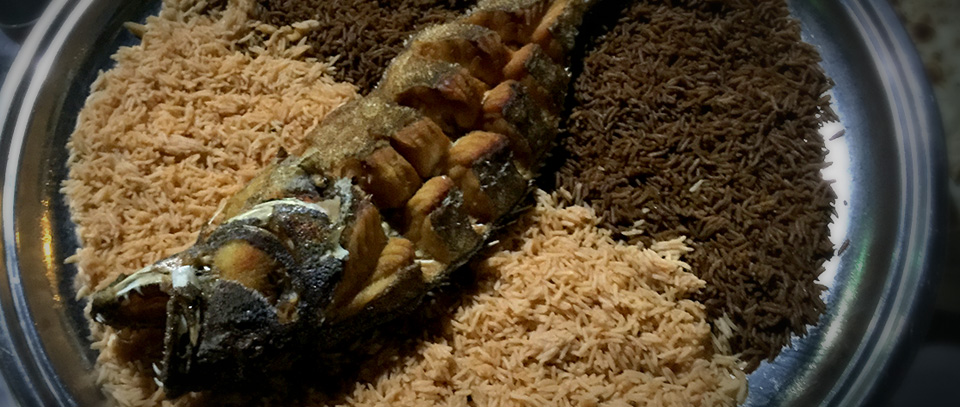
We selected parrot fish (a declining species that is no less tasty for becoming more rare) and grouper. Both were served on beds of two-tone rice. The dark rice was flavored with tamarind, a preferred spice of Saudis. We ate the grilled fish with flatbread and a tamarind sauce, plus fresh hummus and baba ganoush perfect for dragging torn bits of the chewy bread through. Plates of fried shrimp and grilled prawns were also passed along the length of the table. They also served french fries, which remained untouched.

fish-restaurant

We sat outside on rugs on the ground around the low table in the “family” section of the restaurant; all of the women in our group wore long black gowns over their street clothes, though no headscarves or veils were required. The group included Americans, Germans, a Kenyan and a Saudi student named Mohammed who helped us with translation.

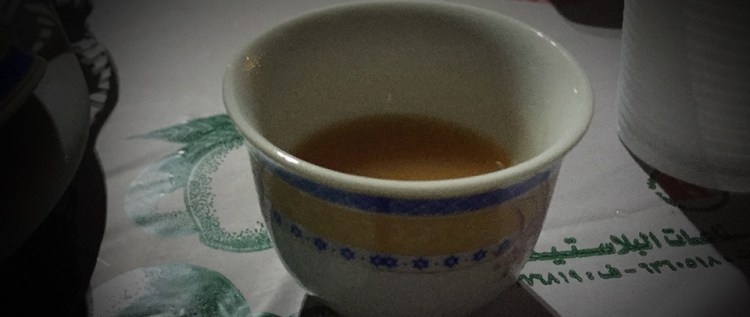
Saudi coffee is another experience in deliciousness. They steep it in un-roasted or partially roasted beans, so it has a hint of green bell pepper bitterness on the palate. It’s great with a touch of milk and sugar. It’s main attraction is its otherness, and it works well to kick off the meal.

In the end, the meal, epic in its scale, range and good conversation, cost us 100 SR apiece, or twenty five bucks.
coffee

Our next local dining experience came a few days latter at a hole-in-the-wall restaurant near the Al Balad historic district of Jeddah. We took the evening KAUST bus (free for university guests!) across ninety kilometers of bleak desert, the Red Sea shimmering elusively on the horizon. We headed straight to the old “souq” or market where you can buy everything from head scarves to abayas and knock-off Beats headphones. We hit town just as the evening prayer was beginning so we sat on the steps of a museum to wait it out while restaurants rolled down their shutters and the crowds thinned as people disappeared into the doors of the mosques that seem to inhabit every block, the haunting and gorgeous prayers echoing through the narrow, twisting, medieval streets.

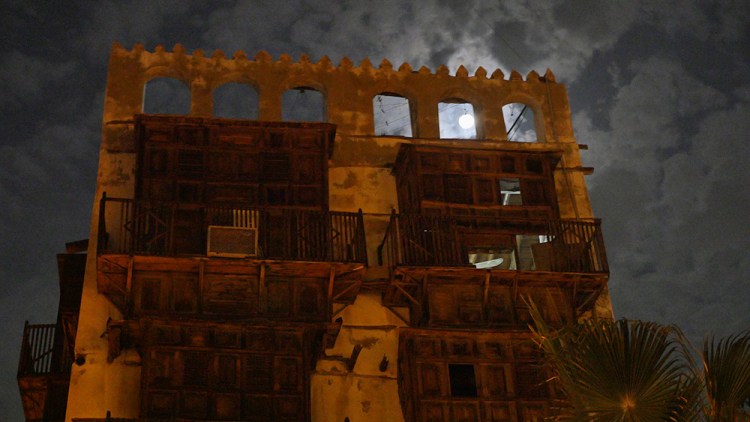
The district’s coral stone buildings loomed over us. The stones seem to be warping, twisting the ancient wooden balconies and window frames with their latticework shutters.

After the prayer, the shops and restaurants opened again. We found a Yemeni cook who was just firing up a wok at a tiny storefront closet of a restaurant fronted by a pair of plastic tables set on the street. Our guide for the evening, an inquisitive German PhD student named Sebastian, asked for shawarma, which was depicted on the inscrutable sign. But evidently they were out, and fortunately so because what we were given instead was more unique and wonderful.

It was a stir-fried blend of ground meat (lamb, beef or both) with onions and an assortment of hot peppers. There was also black pepper and a touch of the ubiquitous tamarind. It was served with slices of red onion and tomato, and instead of the expected rice, we received a stack of baguettes to tear apart for use in shoveling the mixture into our mouths.

jeddah-meal

The meal set us back a whopping 100 SR ($5 apiece) total for our party of five. We were bolstered for the market, ready to do some haggling over headscarves while Jeddah’s seediest characters gathered around our table scraps: the numerous underfed cats who slink out alleys and calmly watch you eat, too proud to beg. The cats are tolerated if not adored like pets back home in Corvallis, and locals will even leave their leftovers hanging from scales on palm tree bark for the cats to claw open and feast upon.

So far our pair of more authentic dining experiences have been a smash. Food is the great reward of travel. I’ve lamented the absence of wine on the table a few times, but then there’s also something to be said for coffee, tea and even-keeled conversation under the echoes of prayers.

We left our new Yemeni friend for the piles of spices at the souq’s vendors and the interesting aromas wafting through the market encouraged more culinary exploration. We wandered the dark alleys, careful not to film people with our cameras to avoid the ire of the religious police, hard-eyed vigilantes who enforce the strict codes that frown upon making images of people.

But the other people we met were open and friendly, and we felt oddly safe and even comfortable wading into the hot throngs again on our way back to the last bus out of town.
albalad2

A Cook’s Tour of Phoenix

I’m working on a story about goat cheese producers around the country, and I had the fantastic opportunity to ride along with Wendell Crow of Crow’s Dairy (Buckeye, AZ) as he made deliveries to Phoenix restaurants. He supplies some of the top chefs in the valley with fresh chèvre, feta and goat milk.

Wendell comes from a dairy family, but he switched from cows to goats in 2006 in a bold move. Most in the business don’t consider goats to be proper “dairying” (yes, they use ‘dairy’ as a verb). So Wendell’s hoping the skeptics will have to “eat crow,” as his license plate indicates. Now, after farming his whole life, he’s getting a glimpse of the good life with kitchen access to fantastic restaurants and resorts in the Phoenix area. He’s on a first name basis with some of the most noted chefs in the business. But despite producing a gourmet product prized by the culinary elite, he still considers himself a farmer. “I guess I’m just a desert rat,” he says in assessment of his life’s work farming on the outskirts of Phoenix.

IMG_6868

I’m be weaving Wendell’s story into a larger article, tentatively titled “American Chèvre.” I’ll be talking with several small-scale cheese producers around the country, plus area chefs and winemakers about the prospects for and benefits of locally produced chèvre and how best to enjoy it.

I’m no expert on chèvre, but I had a chance to try some fresh samples before they’d even been cooled. Crow’s base chèvre was clean and tart, with some bright acidity and a lush texture. He attributes its richness and complete lack of gamey or goaty character to his Nubian herd and careful handling and feeding of “the girls.” Their butter pecan chèvre was decadent, like eating ice cream at room temperature.

Tagging along with Wendall also afforded me a glimpse behind the scenes in kitchens like Pizzeria Bianco, Lon’s and the Phoenix Art Museum. He’s definitely earned their respect through his commitment to quality and hands-on approach to customer service.

More to come.

crow2

An Afternoon on Jenny Creek

Filmmaker Darryl Lai and I recently spent the afternoon in the Cascade-Siskiyou National Monument along the river bottoms of Jenny Creek with Jack Williams, Trout Unlimited’s chief scientist. Jack has fished this stretch since his boys were young. Now they’ve both got graduate degrees, with one of them going into fisheries science like his father, and the other tackling environmental issues with a law degree.Continue reading “An Afternoon on Jenny Creek”

Lila & Dobby make clam fritters

dobby3People express hospitality through food. When someone prepares a meal for a stranger, it’s a form of social grace. It’s what separates us from the animals and thus makes us human. Some might call it a spiritual act.

When someone feeds you four times in two days and gently prods you to continue eating until you’re stuffed to the gills…then the person is something more than merely human. It’s likely that the person is a grandparent.

Continue reading “Lila & Dobby make clam fritters”

A legacy

JIMI

Jimi Brooks died ten years ago today. I never met him. He passed away, at the age of 38, long before I’d ever heard of him. He was an Oregon winemaker. He was an upstart and rebel. And if he were alive today, he’d be one of the most influential people in the business. His story is the anchor of our documentary American Wine Story.

Now, a decade after he left us, despite never once speaking with him, I feel like I know him well. I sometimes can even sense his voice…which I’ve heard only once on a compressed video recording…in my head.

Continue reading “A legacy”

Sunset Beers

I spent a few days on Lizard Island working on a series of stories and videos for Oregon State, as well as shooting a trailer for our next documentary: the very sad and sobering story of the decline of our coral reefs around the world.

There are only a few moments when you can step back and say, “I’m pretty damn lucky.” Being sent to a remote island seventy miles off the eastern coast of tropical Australia could be defined as one of those. Despite the dark undercurrent of the subject matter, plus the long days of solo shooting, interviewing and late nights backing up data, it’s pretty thrilling to visit places few others get a chance to see, and to gain a glimpse of lifestyles and occupations so different from your own.

Continue reading “Sunset Beers”

Bounty under the sun

“The temperature is hovering around 100 degrees right now in Phoenix,” the pilot announced. Then, dryly, “We expect it to climb steadily to two or three hundred by the time we land.”

I have to admit to a little bit of dread over my trip to the Valley of the Sun. The temperate nature of the Willamette Valley has made me weak and intolerant of extremes. I hail from Chicago and Missouri, where conditions range from blistering to arctic with the occasional tornado thrown in. But I’m afraid I’ve lost my Midwestern heartiness.

Continue reading “Bounty under the sun”

The home stretch


After four years, seven states, seventy interviews, three name changes and what seems like an endless process, we’re finally nearing the home stretch. Now we’ve got a rough edit of the film and we’re raising some finishing funds to help us launch the film in 2014. Check out our campaign on Kickstarter, and look for American Wine Story to be screening in the fall and available through digital download.

A tale of American vino

screening

This past Friday we screened our documentary, American Wine Story, for some of the film’s subjects. It was bit of a nail biter as you always wonder how folks are going to react, especially to a film that’s largely about them. The reception was very enthusiastic. This is an inspirational flick about the American Dream in a bottle, not a hatchet job, so the folks involved were bound to enjoy the fact as they’re being positioned in a somewhat favorable light. Now the question remains: how will outside audiences respond? If we take it beyond wine people will the audience find something to pull them into the story?

Continue reading “A tale of American vino”

The Wind Kept: a music video

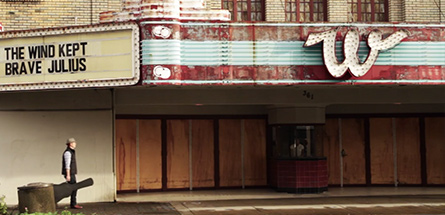
Scene from The Wind Kept
How does a writer who is used to hacking away on a coffee-stained keyboard in some dark corner while mumbling incomprehensibly to no one in particular suddenly find himself part of a team premiering a music video in a historic theatre with a group of collaborators from around the country?

Well, like most things it starts with a conversation during lunch or in some hallway in a crumbling university building. “Let’s make a music video.” I’m not sure if I said it first or if it was Santiago, but one of us uttered that fateful phrase. It seemed like an innocent, wistful thing to say at the time. It reminded me of an earlier conversation with Truen Pence over fried chicken tendons at Corvallis’s best greasy spoon Chinese place where one of us broached the question that has come to dominate our existence for more than three years: “Hey, we should make a documentary about wine.” This music video project started much the same way.

Continue reading “The Wind Kept: a music video”

Nostalgic

“Nostalgic” is a short story I wrote as background when brainstorming ideas for a music video collaboration  for the song The Wind Kept by Brave Julius, which we produced in 2012-2013 and premiered at the Whiteside Theatre on March 16, 2013. Santiago Uceda directed the video and more artfully and imaginatively executed the concept in a way that only  he can.

HE SAW HER ONLY ONCE in church when he was nine, and he never forgot her summer dress, her freckled, peeling shoulders, the scent of lavender and sunburned skin. She glanced at him once, over her shoulder, from where she sat in the pew with the McIntyres, and he felt his back straighten and the hairs rise on his neck. She smiled and he stared, frozen, the only time in his life he’d ever mustered the courage to look at someone so directly for so long.

Continue reading “Nostalgic”

Kickstarting the Whiteside

Here’s a project we’re wrapping up. It’s a music video for acoustic guitarist Brave Julius and director/illustrator/animator Santiago Uceda. We’re raising funds to put on a concert and premiere the video in a classic theater in our hometown of Corvallis, Oregon. It’s a fun project: part filmmaking, part concert and part community art project. Strange how water cooler conversations and a simple email inquiry can turn into something so much bigger. Suddenly we’re trying to find a way to fill an 800-seat theater. No small feat for an artist, writer and musician who are all essentially introverts (I can, admittedly, have a big mouth on occasion).

Fortunately Jaime Williams of the Whiteside Theatre Foundation has quite a bit of event experience and is driving the planning. She’s a passionate advocate of bringing live music to Corvallis, and doing it with class and style via a glorious old venue that was rescued from the brink of demolition. Architecture is community art, and it’s something we often overlook in this culture of the rugged individual. Great wealth, fame or achievement is celebrated, but who still builds beautiful things that truly last these days? That’s why I like filmmaking: it’s a collaborative effort…and to ultimately be successful, you need the community on board in the form of an audience.

Continue reading “Kickstarting the Whiteside”

Ode on a Smith Corona

TypewriterI bought a typewriter off of Craig’s List today. It’s a manual Smith Corona Galaxie XII that I picked up from a house on a Portland side street for thirty bucks. I’m fairly well convinced that it’s quite possibly one of the more beautiful objects I’ve ever owned. Off the top of my head, the only thing that comes close is a powder blue Kramer electric guitar or maybe my Sage fly rod–well, not actually the rod itself but rather its smooth cork handle.
Continue reading “Ode on a Smith Corona”

No excuses

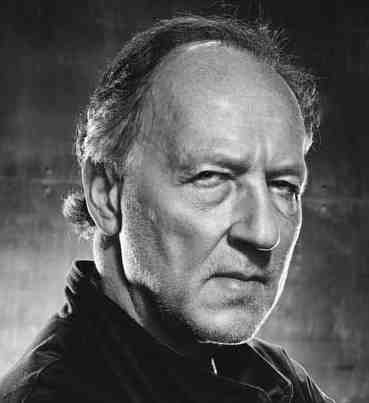
Werner Herzog has been in the business of encouraging young filmmakers since famously eating his shoes in a bet to inspire Errol Morris to make his first film in the 70s. In a recent interview on The Business, Herzog offered some more advice to filmmakers.

Herzog declares that, because of the digital tools available today, there are no excuses for aspiring filmmakers to not make features.

Today it is fairly easy to make a feature film for, say, $10,000…earn the money, don’t wait for financiers. Don’t waste your life to promote your project.

Continue reading “No excuses”

Cooking for a sense of place

Our cousin Eric recently graced us with a visit on his way to Okinawa for his first deployment as a Marine attorney. When someone visits you, it’s both an honor and a gift, and it leaves the host with a certain measure of responsibility. As this was Eric’s first visit to the Pacific Northwest, and his last stop on the way to overseas duty, that responsibility was, if anything, more acute.

Sisters mountains in Oregon

Preparing a meal is perhaps the quickest and most effective way to give someone a sense of place. Eric showed up at the Greyhound station on a redeye bus, so I sent him to the Coast for the day. He’d already offered to buy steaks, but I upped the ante by sending him to a favorite seafood shop on the bayfront in Newport. He returned with fresh halibut, scallops and crab meat in a bag of crushed ice, plus a bottle of pinot noir from a local vineyard. We added asparagus, scallions and fish sticks for Bailey and the result was quite nice.

Continue reading “Cooking for a sense of place”

Wine in Arizona

While down in Phoenix for the in-laws 50th wedding anniversary, I took a side trip down to Arizona wine country in and around Sonoita, gathering footage for our wine documentary project. What I found surprised me. The challenges and risks are there, as they are in any emerging wine region, but not like you’d expect. The problem is too much water at the wrong time, not too little. It’s winter freezes and spring frosts, not the baking desert heat. Here’s a summary clip of the trip.

Writing in strange places

Patricia Ann McNair holds some measure of responsibility for the fact that I still write stuff. I’m not sure that she deserves praise or derision for this dubious honor. But in all truth, she’s the sort of selfless writer who can be a mentor, friend and teacher, all the while passionately pursuing her own craft.

Her book Temple of Air is coming out this fall.

She was also recently kind enough to include me in her blog series, Views from the Keyboard.

The Immigrants

They slouch across oceans, across borders, have been for years, leaving a trail of footprints, litter, hope, the occasional corpse.

They descend on our fields, neck-deep in crops dusted with pesticides, the spore of new construction, bringing life to otherwise dying small towns in Kansas.

Many have the audacity to bring their families, to stay, sometimes for generations, and to speak the language given to them by the Conquistadores for a while before eventually losing it.

Often, they sing.

And they’re singing now. A family, several families, maybe thirty of them have rented a rowboat on a crystal lake that drowns a hidden forest amid frozen lava flows, an ancient reminder that this part of our country is still considered young by geologists, changing, heaving, convulsing beneath our very feet, reducing the idea of maps, borders, to a silly notion.

Eight of them crowd into the rowboat while the rest wait their turn on shore. The oars squeak as they zigzag, leaving little whirlpools from each kiss of a blade on the water. They draw sideways stares from the other fishermen, but they don’t care.

My daughter is fascinated by their joy. The smiles on the faces of the children. So much more compelling than my insistence on fish that never materialize. She sings along. It’s all one language after all.

And we’re both glad that they’re here.

Kickstarter campaign

We’ve launched a Kickstarter campaign for our current documentary film project. It feels strange asking for money, but then that’s how it works in the indie film world. I suppose I’m getting used to it. And Kickstarter is much better than going door to door selling overpriced caramel corn like when I was in the Boy Scouts.

Ultimately, it’s about building an audience as much as it is about raising a few bucks so that we can travel to places and shove cameras in peoples’ faces.

Since our subtitle is “An American Wine Movie,” and we are trying to tap into a national personality trait that makes folks in the New World chuck everything to follow a crazy dream, we decided to end our campaign on July 4th.